


Skip to content
Method

Sequence, applied to a contractor's back office

Decompose, digitize, integrate. The same method that collapsed a manufacturing line from thirty-two operations to one, run on a twenty-year construction business.

Thirty-two small operations along a line converge into a single setup, from which one signal leaves: the origin of the Sequence method. 32 OPERATIONS 1 SETUP CV-JOINT LINE ORIGIN OF THE METHOD DIGI-DNA · NOTES 2026-10-16 32 → 1 PLATE

Sequence was forged on a machining floor: find the one operation that makes the part, capture it in a single setup, remove every handoff that is not the part. This year we ran the same procedure on a general contractor's back office.

Operations per part, CV-joint lineUnit · operations
The constant-velocity joint line went from 32 operations per part to a single hard-tooling operation.Before Sequence: 32 operations; After Sequence: 1 operations010203040Before Sequence32After Sequence1
Fig. 1Where the method was forged: thirty-two operations collapsed into one setup on a mill-turn.Source: Digi-DNA case study, 32 → 1: the CV-joint line (/work/cv-joint-line).

Decompose

The irreducible unit of a construction business is the job, moving from lead to quote to proposal to work to payment. Everything else, the calls, the vendors, the invoices, the marketing, is either a view of a job or an action on it.
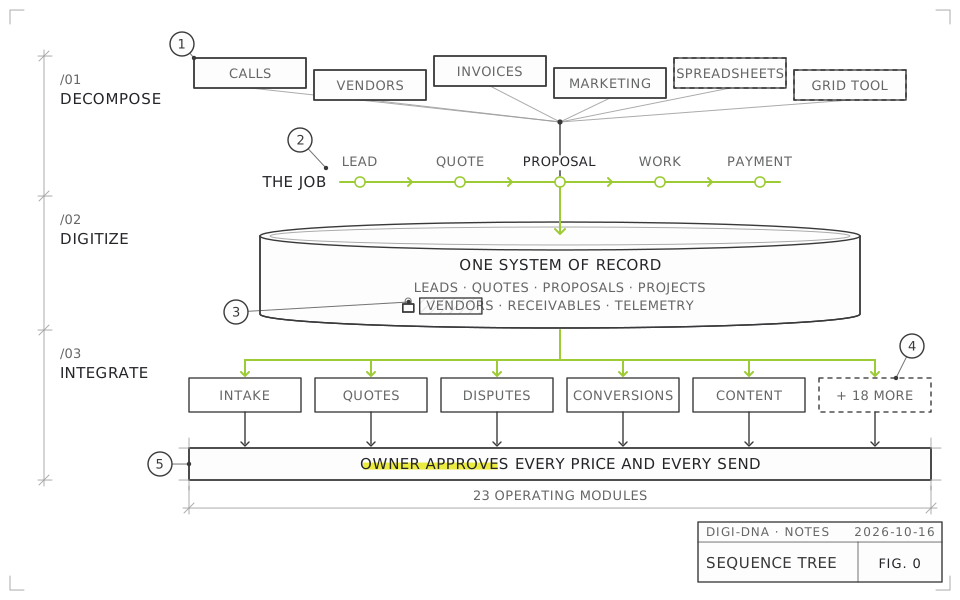
An hourglass-shaped tree. At the top, scattered fragments of the back office (calls, vendors, invoices, marketing, spreadsheets, a paid grid tool) converge onto the job, which moves from lead to quote to proposal to work to payment. The job drops into one system of record. From the record, modules fan out: intake scoring, quote drafting, lead disputes, conversions and content, twenty-three modules in all, each passing through the owner's approval. /01 DECOMPOSE /02 DIGITIZE /03 INTEGRATE CALLS VENDORS INVOICES MARKETING SPREADSHEETS GRID TOOL LEAD QUOTE PROPOSAL WORK PAYMENT THE JOB ONE SYSTEM OF RECORD LEADS · QUOTES · PROPOSALS · PROJECTS VENDORS · RECEIVABLES · TELEMETRY INTAKE QUOTES DISPUTES CONVERSIONS CONTENT + 18 MORE OWNER APPROVES EVERY PRICE AND EVERY SEND 23 OPERATING MODULES 1 2 3 4 5 DIGI-DNA · NOTES 2026-10-16 SEQUENCE TREE FIG. 2
Fig. 2Decompose, digitize, integrate. (1) Fragments are views of a job or actions on it. (2) The job is the irreducible unit. (3) One system of record; vendor data masked and access-logged. (4) Twenty-three modules read the same record. (5) The owner still approves every price and every send.Full-size drawing for Fig. 2 (SVG)

Digitize

Every fragment moved into one Postgres system of record: leads, quotes, proposals, projects, vendors, receivables, and the telemetry of who viewed which proposal and when. The spreadsheets and the paid grid tool were retired. Sensitive vendor data is masked and access-logged by design.

Integrate

The value lived in the connections that used to be manual. Intake now scores and routes every lead. Quotes are drafted from the record. Ad-platform lead disputes are filed programmatically, and qualified leads flow back to the ad platform as conversions. Search content opens a reviewed pull request twice a month. Twenty-three operating modules read the same record.
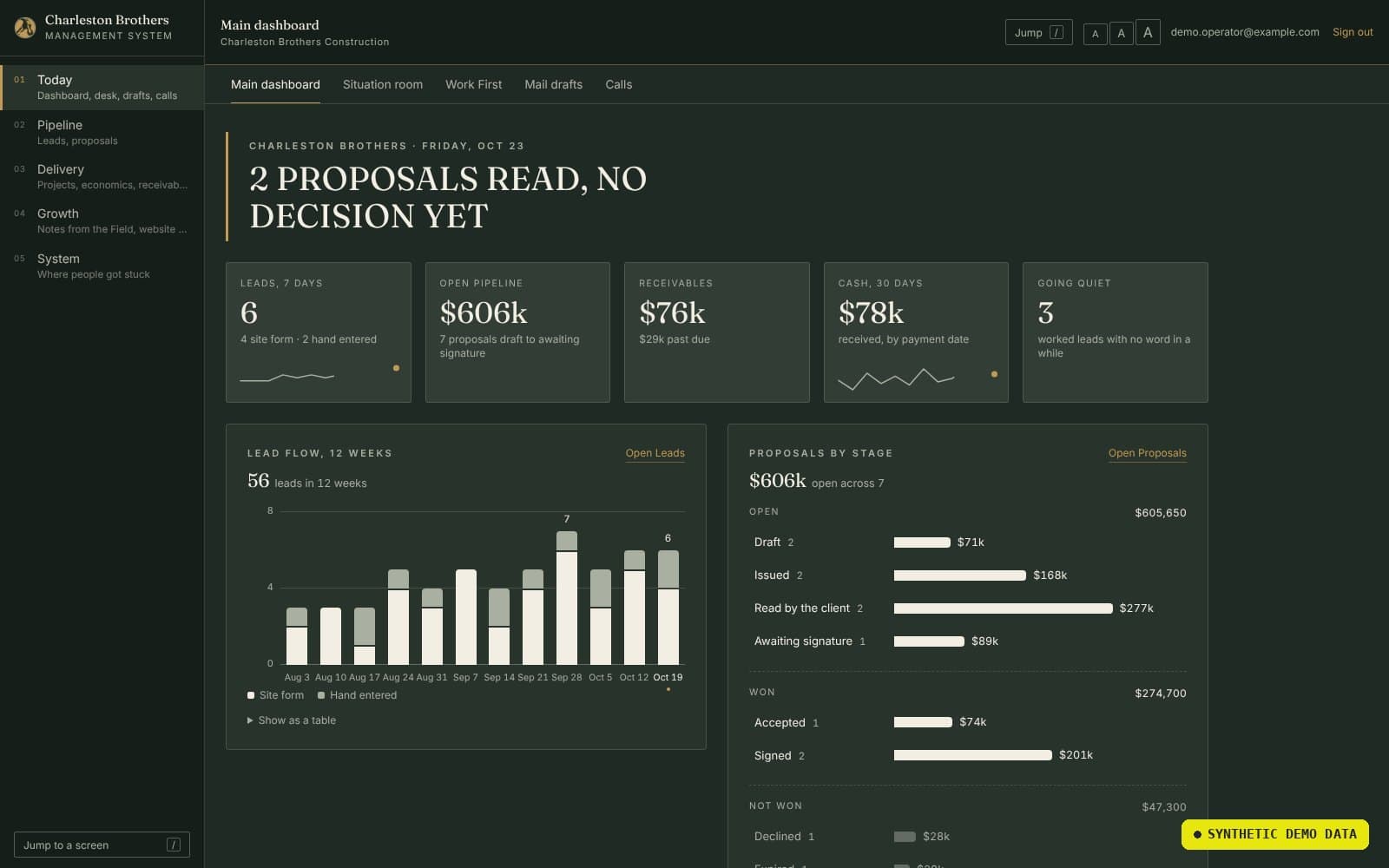
Operating console for a general contractor: leads, open pipeline, receivables and cash tiles above a twelve-week lead-flow chart and proposals grouped by stage.
Fig. 3One record, every function: the contractor's operating console.Screenshot of the running system on synthetic demo data; no client records shown. Client: Charleston Brothers Construction, shown as a separate entity; no endorsement implied.

What did not change

The owner still approves every price and every send. Sequence removes handoffs; it does not remove judgment. That is the difference between automation a business tolerates and automation a business adopts.

Build the system behind the outcome.