


Boeing 787 — the LG vision tablet
A first-tier Boeing vendor sets a meeting, secures an LG audience, and proposes a 3D vision tablet to speed 787 production — a decade before the shop floor was ready for it.
A system with no coordinating layer.
Aircraft production at 787 scale is a coordination problem: thousands of parts, tight tolerances, and operators who need the right spatial information at exactly the right station. In 2011 that information lived on paper and in disconnected systems. The question was whether a vision-equipped tablet could put a live, three-dimensional picture of the build directly in the operator's hands and speed the line.
Decompose. Digitize. Solve at the integrations.
The Sequence method, applied end to end — the same move that runs through every Digi-DNA project.
The station is the unit
Reduce a vast production program to the single operator at a single station who needs to see the build correctly to act.
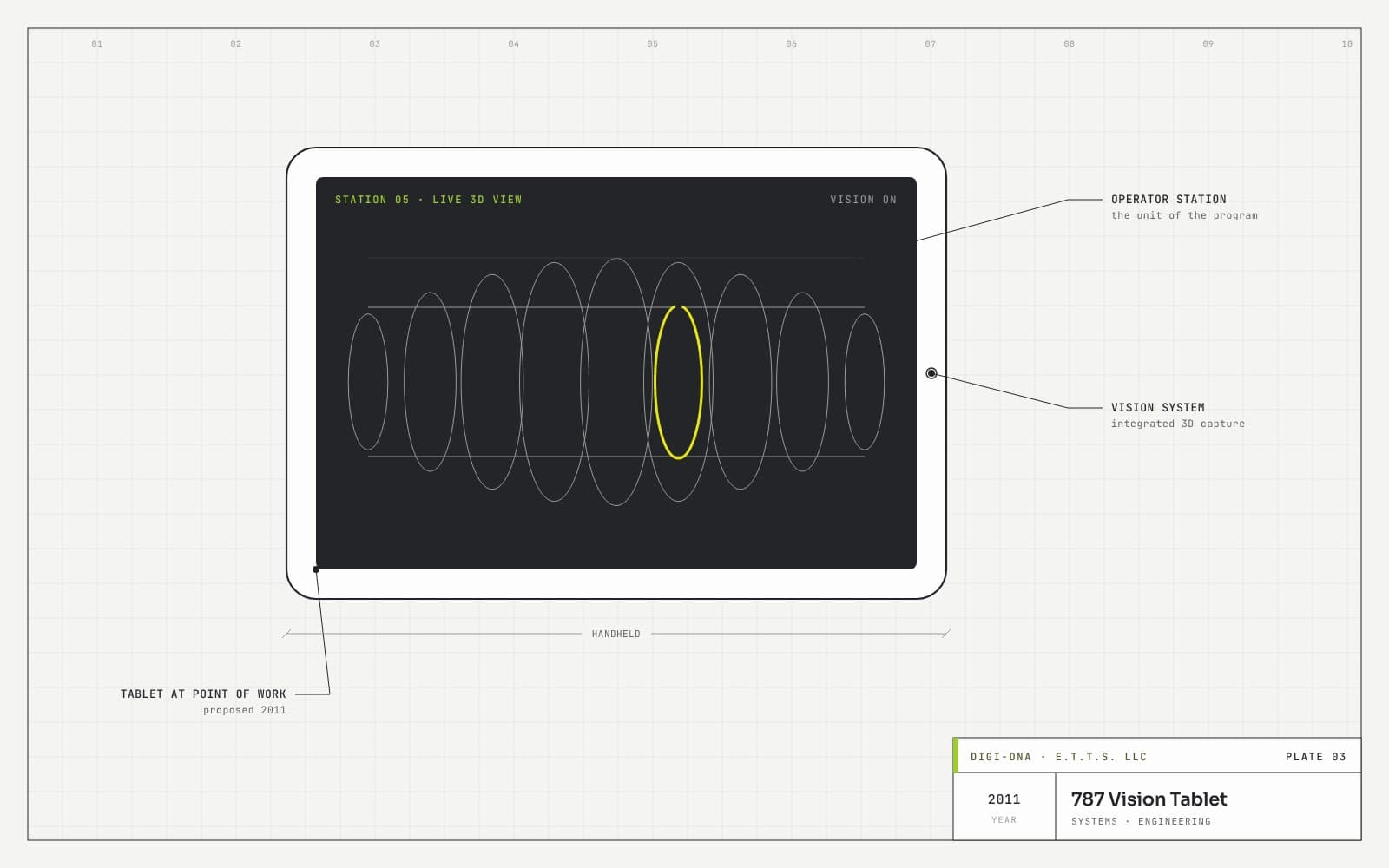
A 3D vision system, in hand
Pair a tablet with an integrated vision system so the physical build is captured and rendered in three dimensions at the point of work.
Broker the partnership
Solve at the connection between the manufacturer and the technology — set the Boeing meeting, secure the LG audience, and align a first-tier vendor, an OEM, and a vision-hardware maker on one program.
The concept was early and right. Vision-guided tablets on the production floor arrived across manufacturing years later. The same "early-and-right" pattern — and the same instinct to put intelligence at the operator's station — runs straight into Field Operations AI.
Early, and right.
- Reached the room — a first-tier Boeing vendor secured the LG audience and set the program meeting.
- Defined the concept — a 3D vision-system tablet to speed 787 production, proposed in 2011.
- Ahead of its time — the line couldn't absorb it then; vision-guided field tablets became standard later.