


32 → 1: the CV-joint line
Take an over-built manufacturing line, find the one operation that matters, and remove everything that isn't it. Thirty-two operations became one. This is where Sequence was forged.
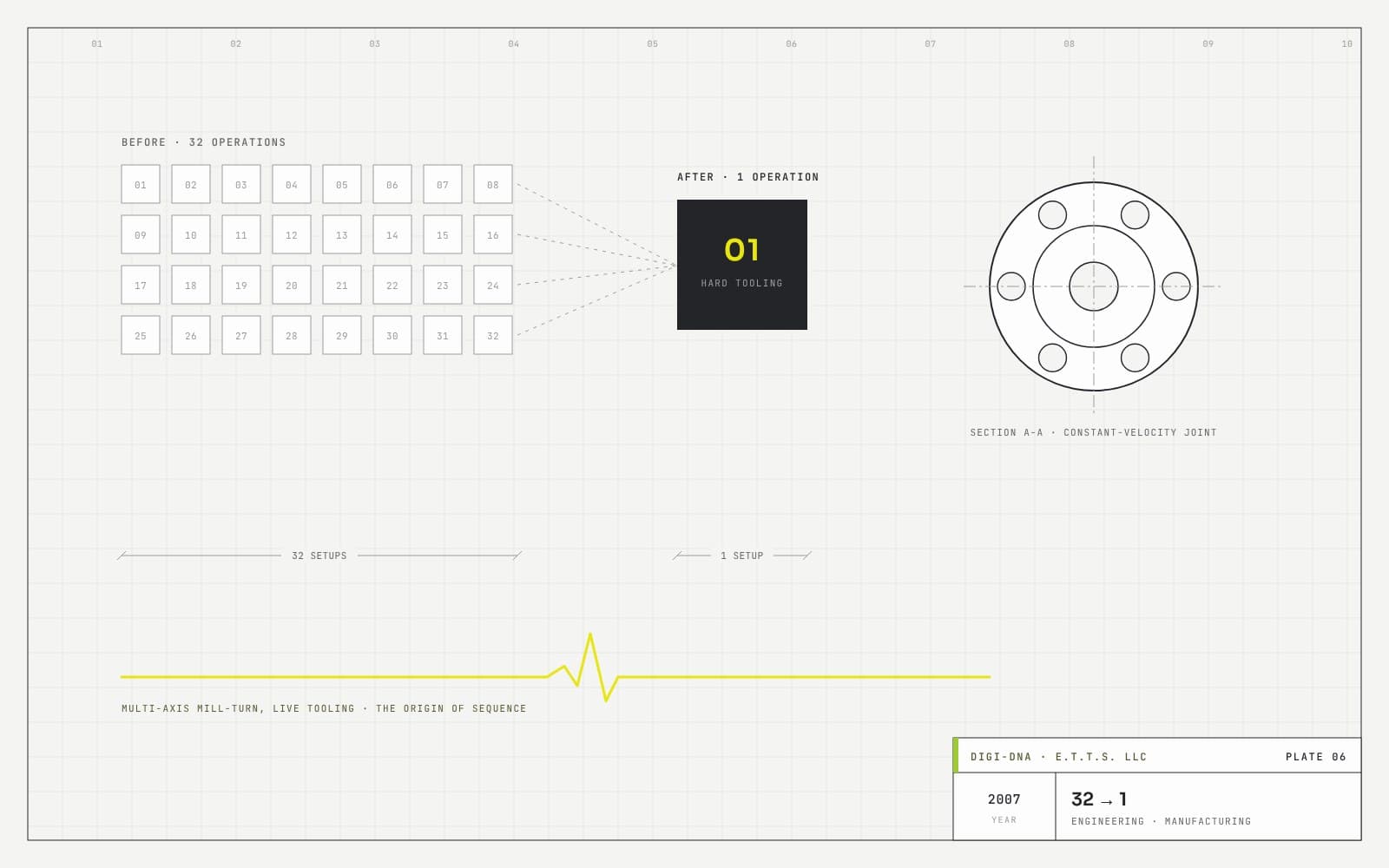
A system with no coordinating layer.
A constant-velocity joint was being produced across thirty-two separate operations — thirty-two setups, thirty-two chances for drift, thirty-two places to lose time and tolerance. The line was over-built. The question a non-engineer asked from first principles: what is the single operation that actually makes this part, and can everything else be removed?
Decompose. Digitize. Solve at the integrations.
The Sequence method, applied end to end — the same move that runs through every Digi-DNA project.
Find the one operation
Reduce a thirty-two-operation line to the irreducible operation that actually defines the finished part.
Multi-axis live tooling
Re-express the part on a then-new Mori Seiki NT-series mill-turn with live tooling — capturing the geometry in a single, hard-tooled, multi-axis setup.
Collapse the line
Solve at the setups: fuse thirty-two operations into one hard-tooling operation, removing every handoff that wasn't the part itself.
This is the literal origin of the method. "Figure it out" became "32 operations to 1." Every Digi-DNA build since runs the same move — decompose, digitize, solve at the integrations — first proven here, in metal.
Thirty-two to one.
- 32 → 1 — a constant-velocity joint line collapsed from thirty-two operations to a single hard-tooling operation.
- At the technology frontier — executed on a then-new multi-axis mill-turn with live tooling.
- The origin of Sequence — the method the whole practice now runs was forged here.