


Watchtower: a manufacturing control tower
Battery manufacturing now runs under overlapping sourcing, tariff, and evidence regimes. Watchtower puts every compliance question for a component into one view and one exportable record.
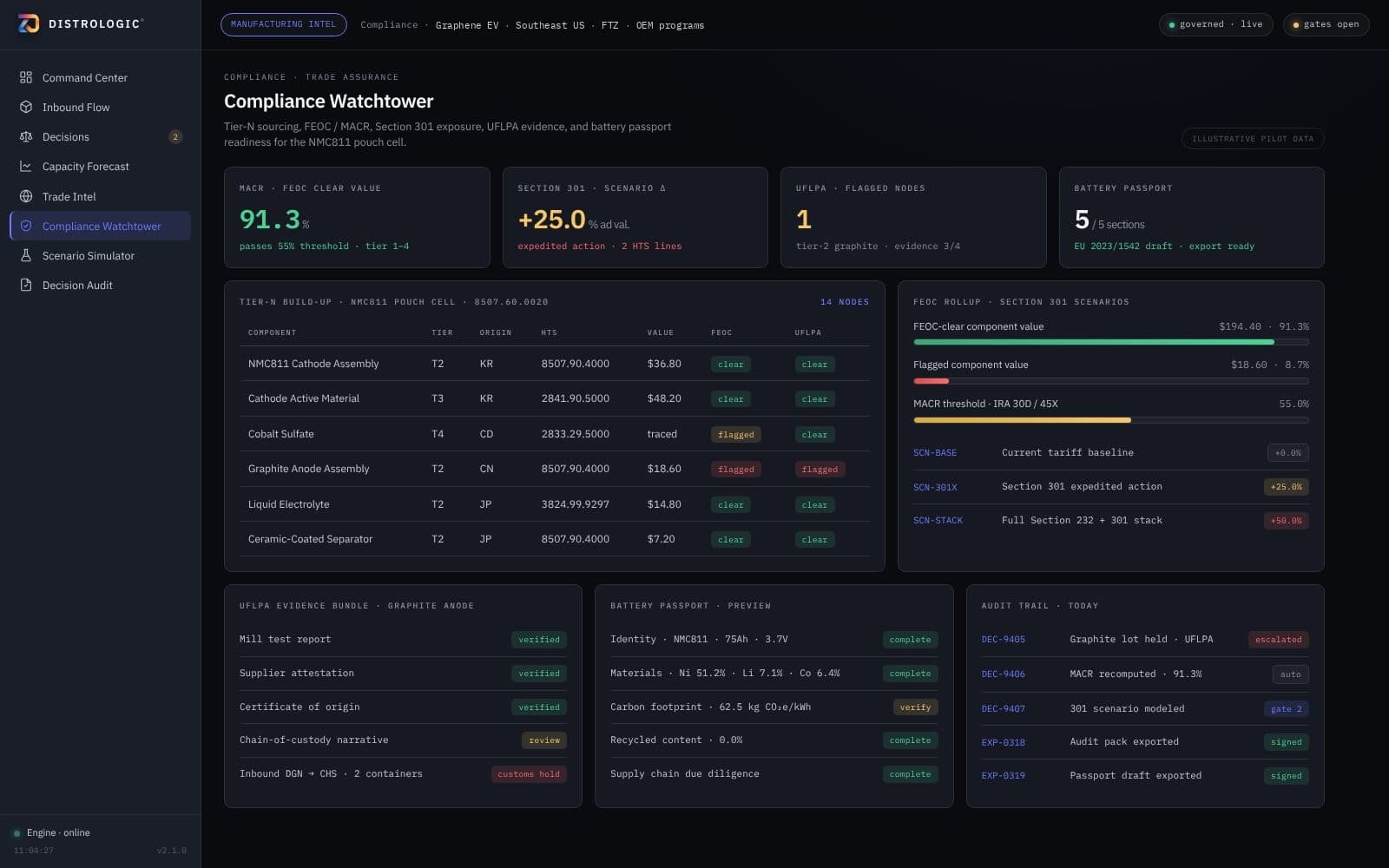
Compliance evidence scattered across the supply chain.
For an EV battery manufacturer, a single component can carry foreign-entity sourcing restrictions, tariff exposure, forced-labor evidence obligations, and battery-passport reporting at once. The evidence sits with suppliers, brokers, carriers, and internal systems, each holding a fragment. The question was whether every one of those obligations could be answered from one coordinated view, with evidence an auditor would accept.
Decompose. Digitize. Solve at the integrations.
The Sequence method, applied end to end — the same move that runs through every Digi-DNA project.
The component's obligations
Reduce the supply chain to one component and the five questions it must answer: sourcing eligibility, tariff scenario, forced-labor evidence, passport data, and audit trail.
A seeded, labelled dataset
Model the obligations against a synthetic dataset, explicitly labelled as illustrative, and express passport data in a structured, exportable format.
One tower, one export
Bring every obligation into a single control console and close with an audit export that carries the evidence chain, so the answer and its proof travel together.
A control tower is building intelligence for a supply chain: sense the state, surface it to operators, act under rules, and verify. The pilot was designed to prove that loop in thirty days.
Screens and features.
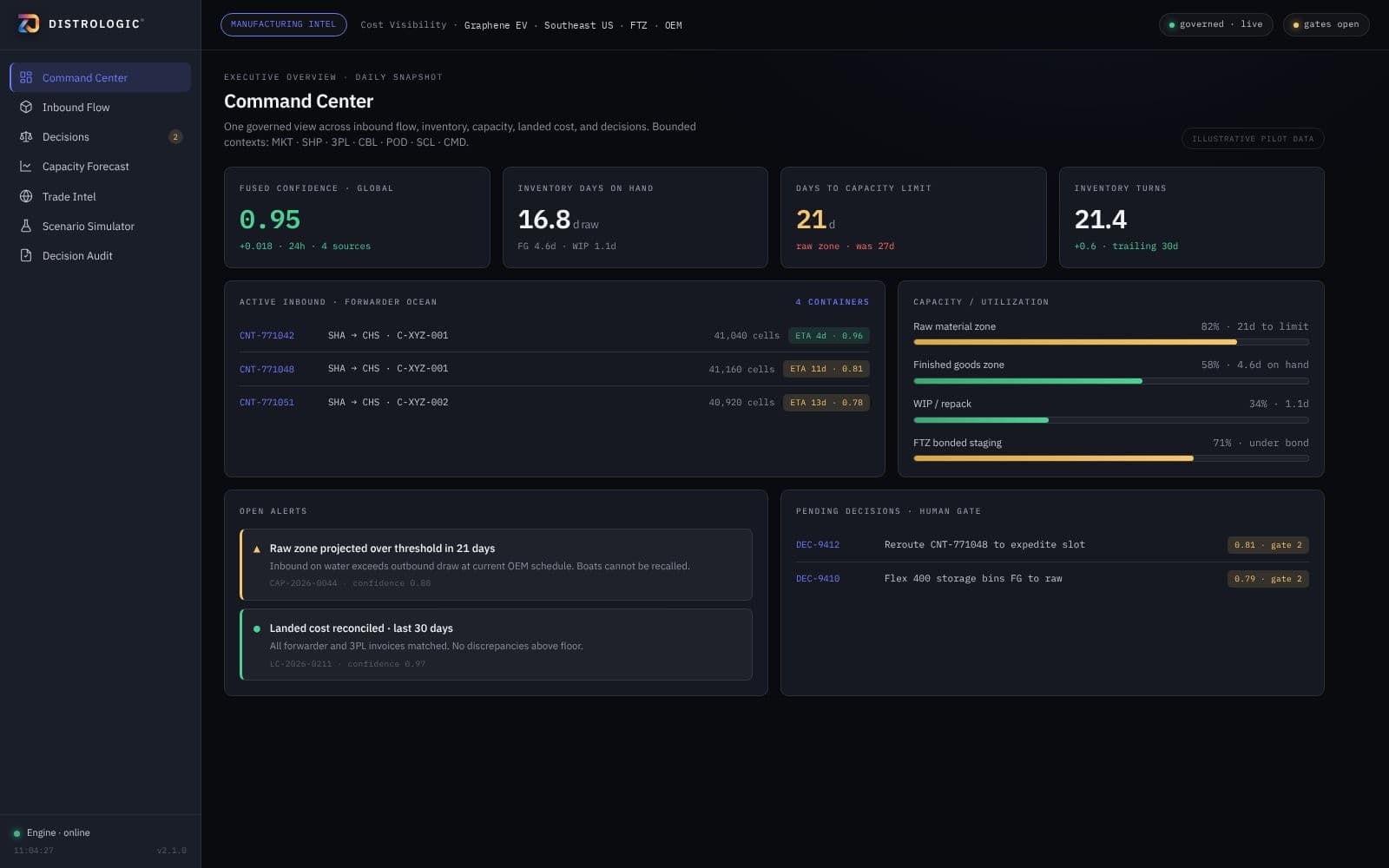
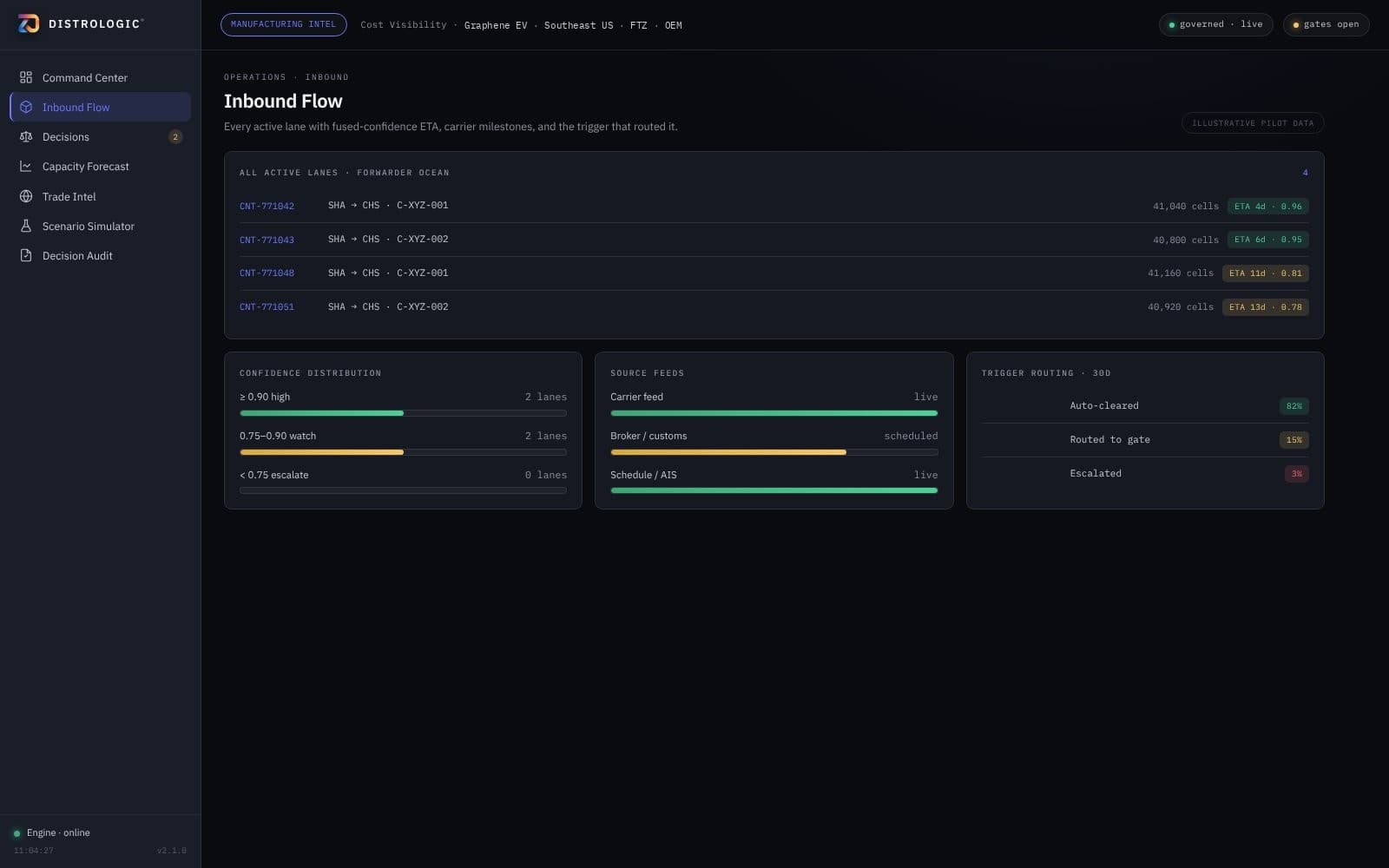
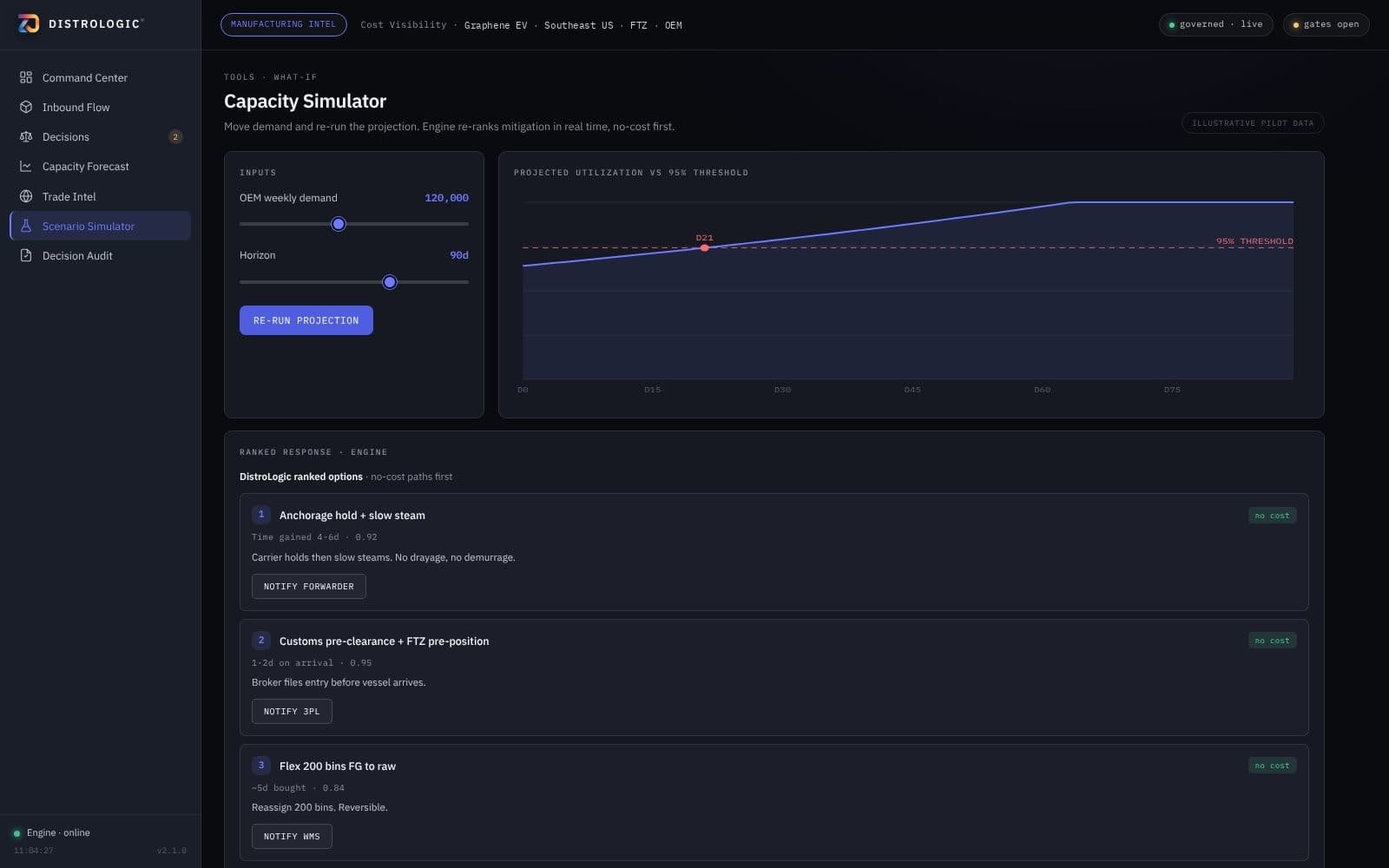
Five obligations, one view.
- Five-part proof of value — sourcing compliance, tariff scenarios, forced-labor evidence pack, battery passport, and audit export, run as a single scripted demonstration.
- Thirty-day pilot design — scoped with carrier readiness graded before go-live rather than assumed.
- Honest data — every figure in the demonstration labelled as illustrative pilot data.