Race-Let — the founding wearable
The first device to carry your digital DNA: identity, medical history, and positioning on the wrist. Built for one of the largest road races in the country — years before the wearable category caught up.
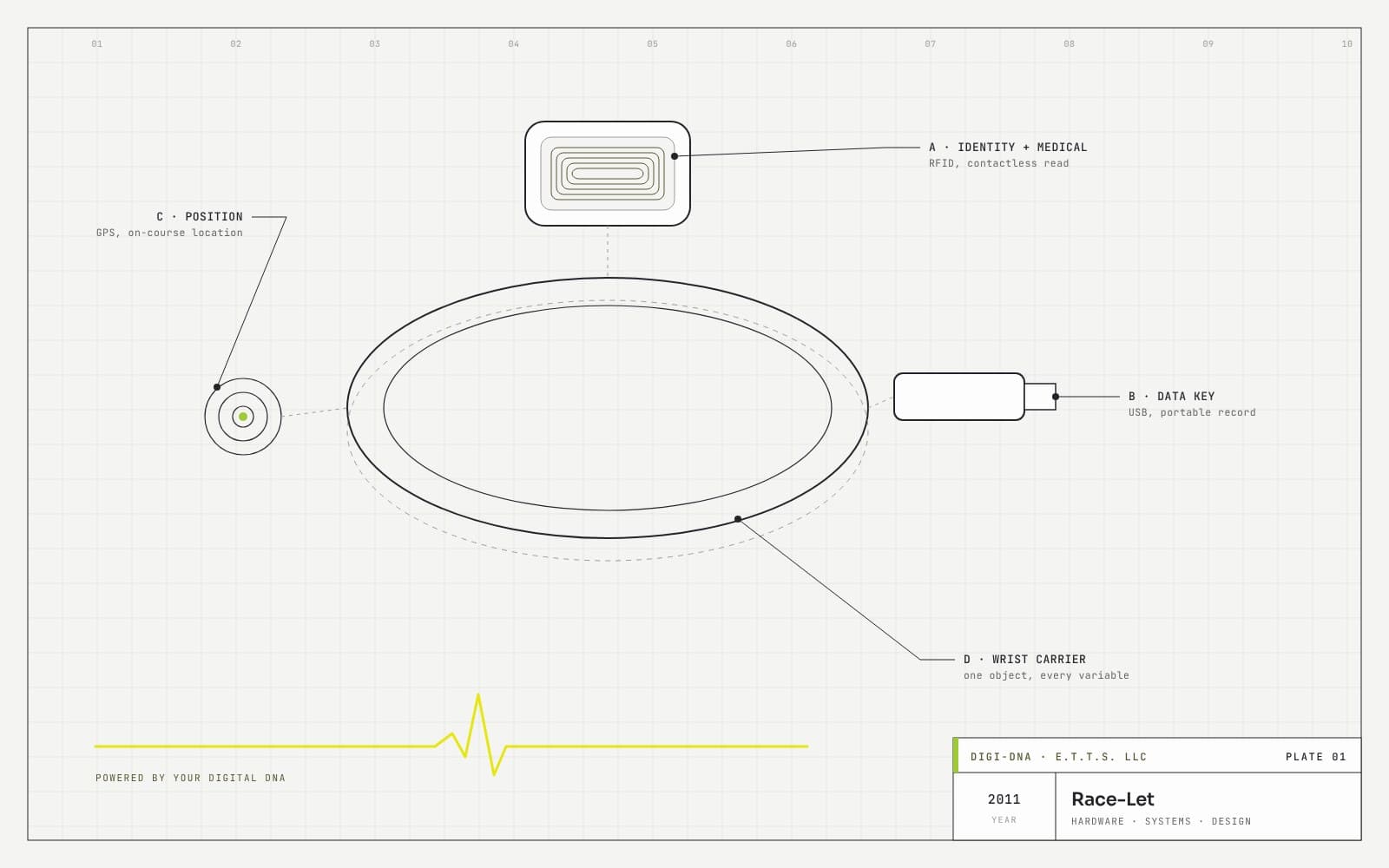
A runner is a system with no coordinating layer.
At a race the size of the Cooper River Bridge Run — tens of thousands of participants — a runner's identity, medical information, timing, and location live in separate, disconnected places. Paper bibs. A timing chip. An emergency contact card. A phone left in a bag. Each fragment solves one thing and talks to nothing else. The question wasn't "what gadget can we sell a runner." It was: what is the smallest thing a person could carry that makes all of those fragments behave as one system?
Decompose. Digitize. Solve at the integrations.
The Sequence method, applied end to end — the same move that runs through every Digi-DNA project.
The irreducible unit
Strip the runner to what actually has to travel with the body: who they are, what a first responder needs, and where they are. Everything else is downstream of those three.
Every variable, one carrier
Put identity, medical history, and positioning onto a single wrist-worn device — RFID for contactless read, a USB key for data, GPS for location. One object, every variable.
Solve at the connections
The value wasn't the wristband — it was the integrations: bib-to-identity, identity-to-medical, runner-to-course, device-to-event. The band made the fragments behave as one system.
"Powered by your Digital DNA" — the smallest part of a person that makes the whole event legible.
This is the through-line. The same move — find the irreducible unit, digitize it, solve at the integrations — would later become the sensing platform, the Kernal orchestration layer, and the named method itself. Race-Let is where it started in the physical world.
Right idea, early.
- Proved the thesis — a single wrist-worn carrier could unify identity, medical, and positioning into one coordinated system.
- Deployed against a real event — designed for the Cooper River Bridge Run, not a lab demo.
- Seeded the platform — became Digi-Band, the Digital-DNA application suite, and ultimately the sensing platform.
- Ahead of its time — the consumer wearable category and the infrastructure to support it arrived years later. The same early-and-right pattern recurs across the practice.
In memory of Julian Smith (1951–2019)
Race-Let was developed in collaboration with Julian Eugene Smith III, longtime director of the Cooper River Bridge Run from 1994 to 2019, who grew it into one of the largest road races in the country. We're grateful for his partnership and his belief in building something ahead of its time.