



Recon3: house-account reconciliation
When a system only knows the present, nobody can prove the past. Recon3 gives a marina's house accounts a memory, then reconciles that memory against the books every night.
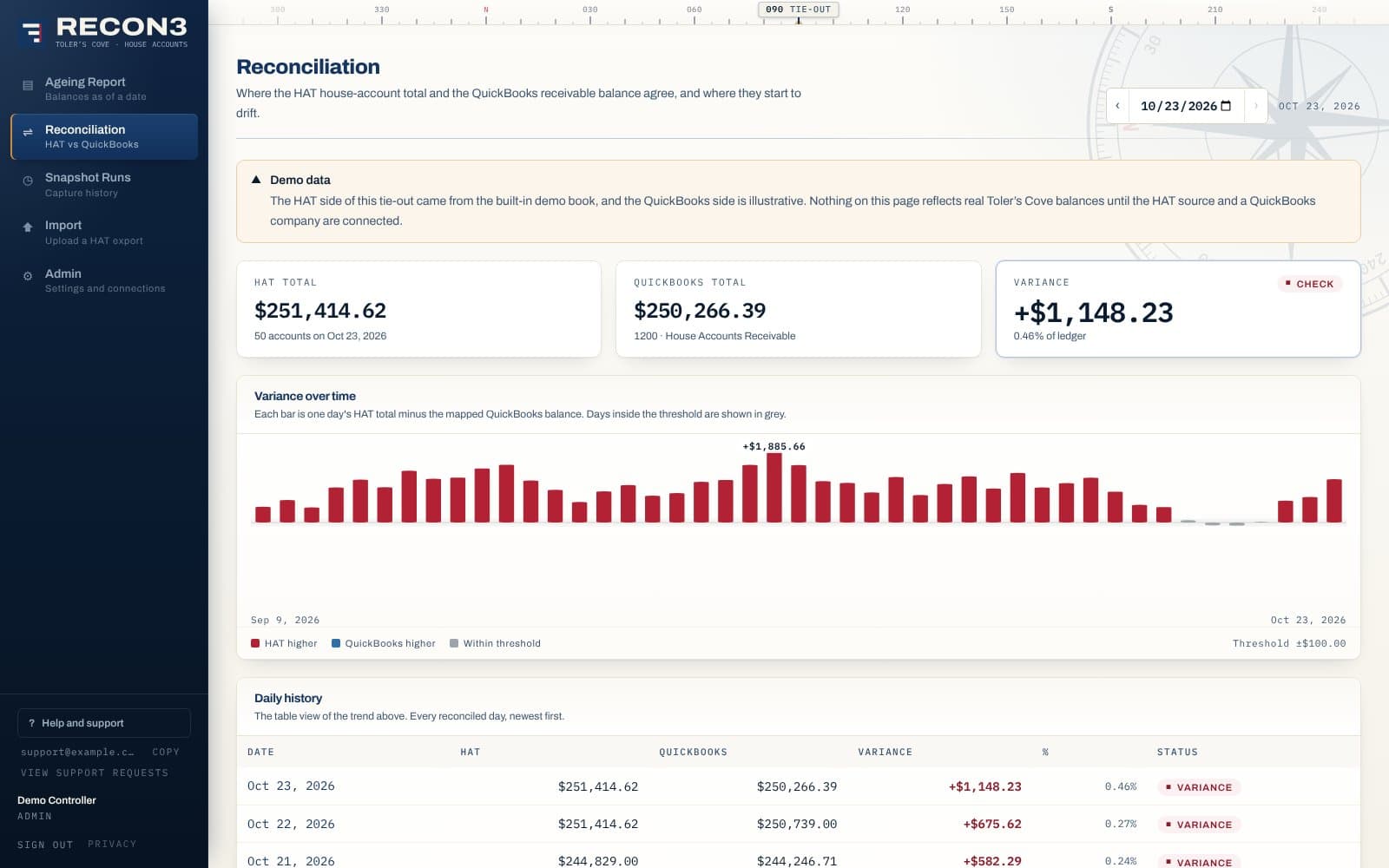
A live balance with no history.
Members run house accounts at the marina's point of sale. The house-account app shows what is owed right now and nothing else. There is no record of what was owed last Tuesday, so tying the month to the accounting system meant reconstruction and judgment calls. Worse, charges could be landing in accounting as cash rather than receivables. The question was how to give a system with no memory a provable history, and reconcile it honestly.
Decompose. Digitize. Solve at the integrations.
The Sequence method, applied end to end — the same move that runs through every Digi-DNA project.
The nightly balance
Reduce reconciliation to its irreducible unit: every account's balance on a given date, compared to the books on that same date.
Immutable snapshots
Capture every balance nightly into an append-only store. Re-running a date never overwrites a good run. Credentials for connected systems are encrypted at rest.
Reconcile, then cross-check
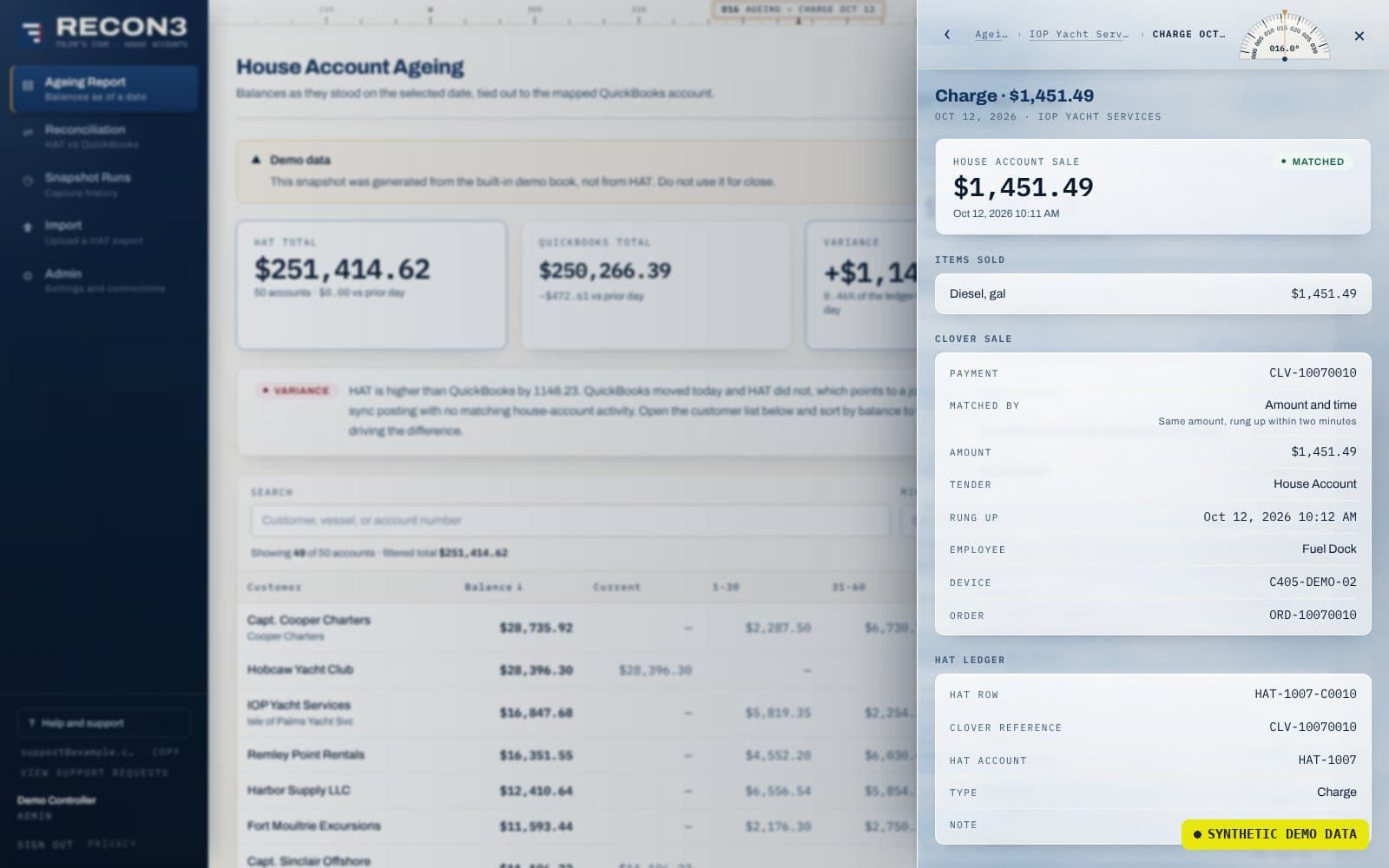
Pull the matching receivable from accounting and record the difference. Flag a day only when it breaches both a dollar and a percentage threshold. Cross-check charges against card-processor payments and record the basis for every match.
If reconstructed ageing does not tie to the source's own total, Recon3 reports the balance unaged rather than show buckets that disagree.
Verification is the fifth primitive of Kernal, and here it is the whole product: the system claims a balance, the books claim a receivable, and Recon3 proves whether they agree.
Screens and features.
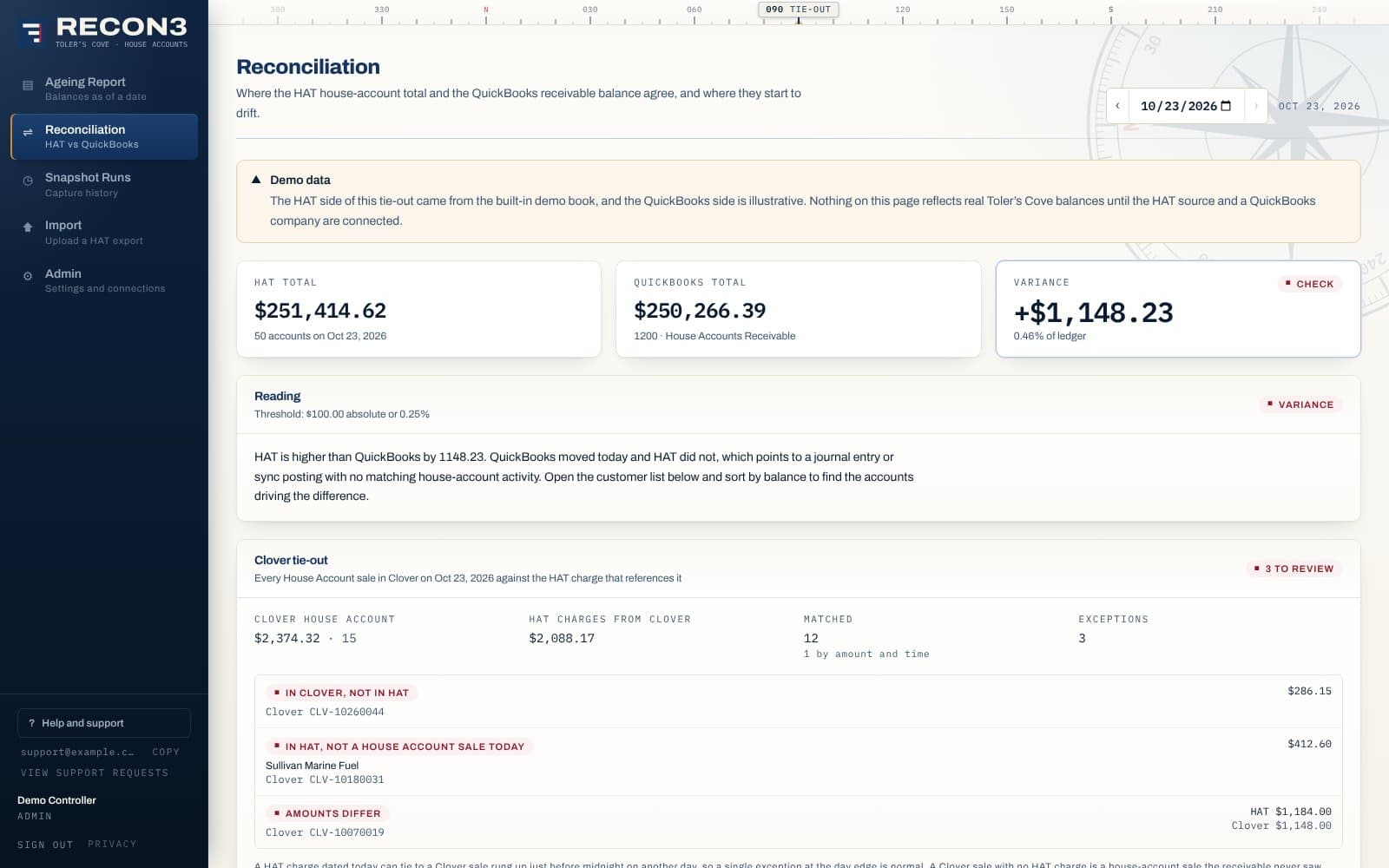
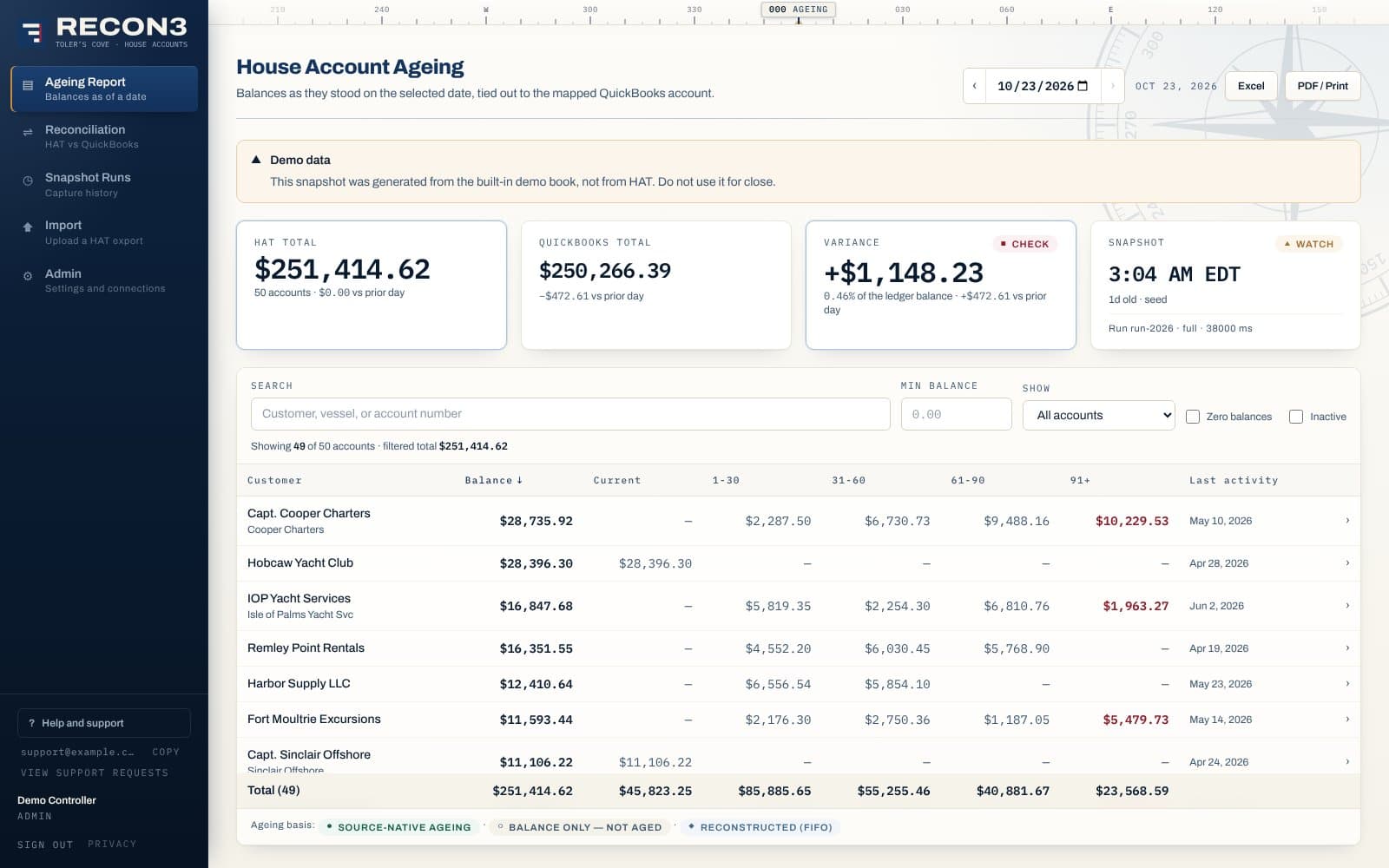
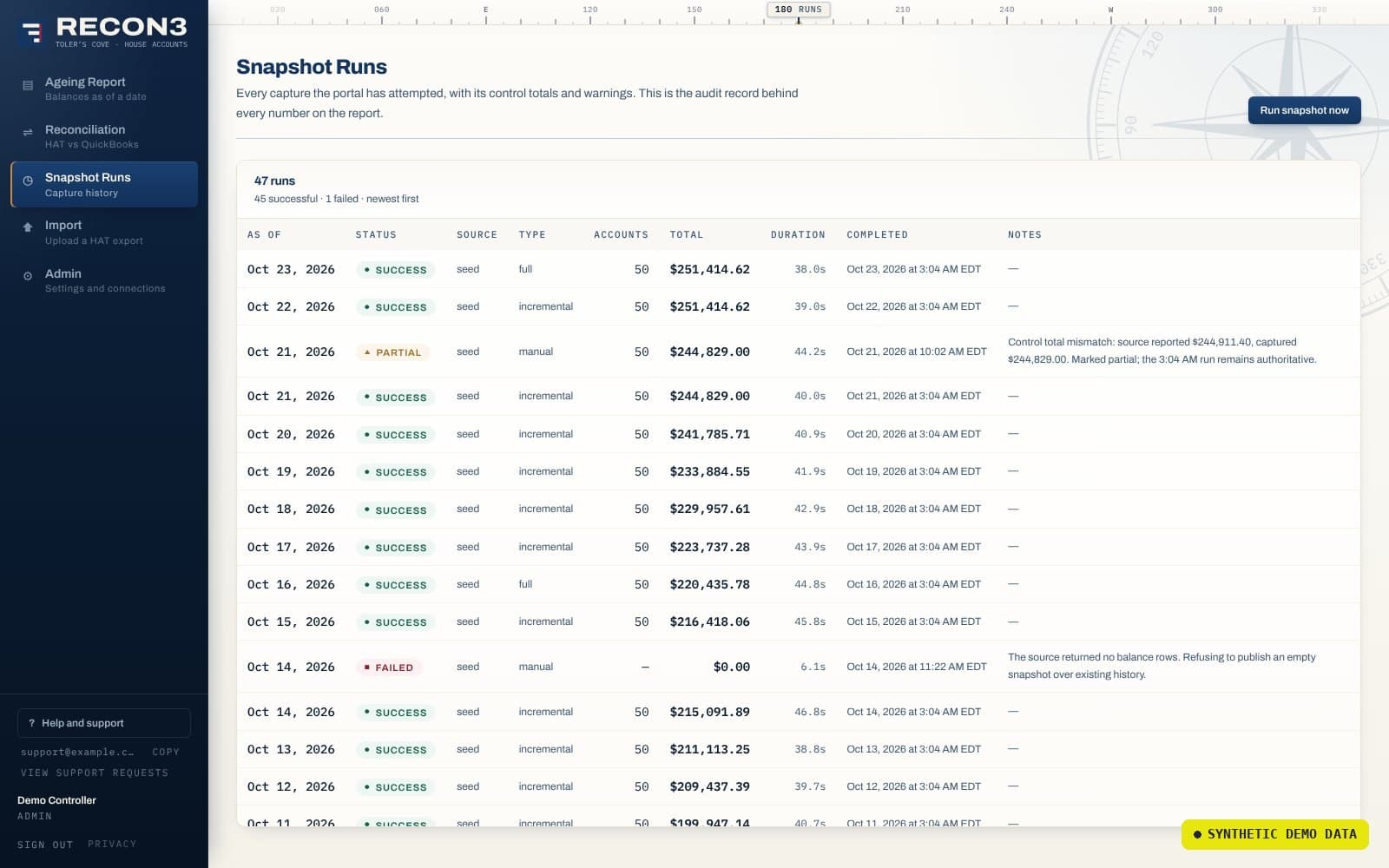
The books, with a memory.
- Provable history — a nightly, immutable record of every house-account balance from go-live forward.
- Honest exceptions — dual-threshold flagging, so finance reviews real breaks rather than noise.
- Cross-checked — point-of-sale charges matched to processor payments with the match basis recorded; seven of seven matched on the first day of real data.
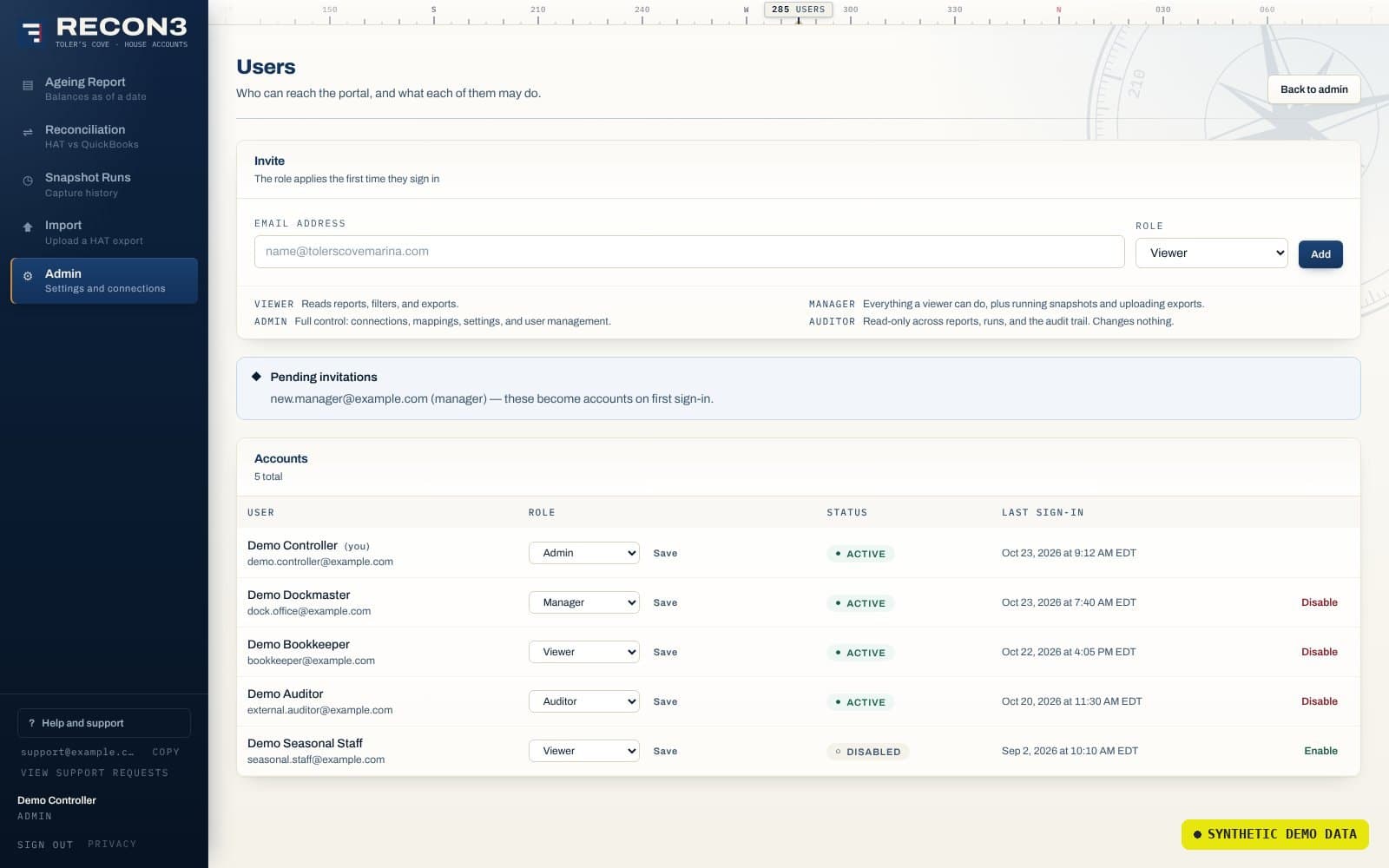
- Governed access — four roles (viewer, manager, auditor, admin), row-level security, and audit-ready exports.