


The sensing platform
Read the body mechanically, not through proxies. Muscle sensing fused with flight-controller-grade motion sensing — the platform thesis behind everything since.
A system with no coordinating layer.
Reading the body usually means electrodes, gels, and signals that drift — proxies for what's actually happening in the muscle and the movement. The question was whether you could sense the body mechanically and directly, and fuse that with motion sensing precise enough to trust — without wiring a person up.
Decompose. Digitize. Solve at the integrations.
The Sequence method, applied end to end — the same move that runs through every Digi-DNA project.
Muscle and motion, first
Reduce "reading the body" to two irreducible signals: the mechanical action of the muscle and the precise motion of the body.
Mechanical sensing + IMU
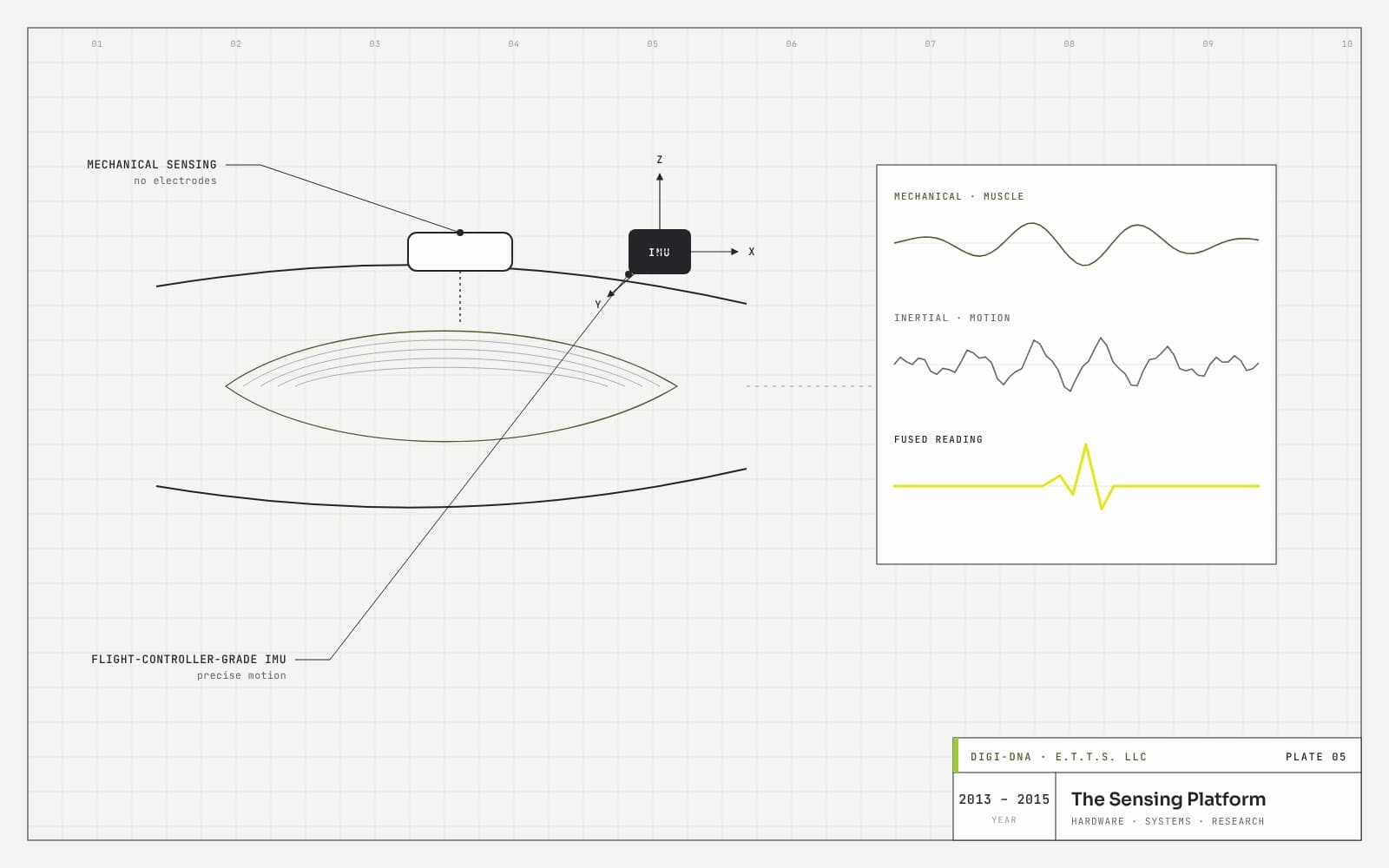
Capture muscle action mechanically and pair it with a flight-controller-grade inertial measurement unit — reading the body without electrodes.
Sensor fusion
Solve at the integration between the two signals: fuse mechanical and inertial data into one trustworthy reading of what the body is doing.
This is the platform thesis. The RC-car-to-drone instinct — flight controllers and IMUs — grew up here into a way of sensing the physical world directly. It leads straight to Digi-Sense.
A way to sense the real thing.
- Electrode-free sensing — a mechanical-first approach to reading the body directly.
- Sensor fusion — mechanical muscle sensing fused with flight-controller-grade IMU into one reading.
- Research-grounded — developed alongside formal study in autonomous flight (TU Munich) and underactuated robotics (MIT).
- Set the thesis — became the foundation for the current sensing instrument.